The Arthur Adams Virtual Museum Main Menu

1980 Guardian of the Imagination - Ink & Watercolor (August 19th, 1980)
During the summer of 1980, Arthur Adams devoted much of his free time to studying the paintings and drawings of Frank Frazetta. Fascinated by the fantasy worlds Frazetta created, the seventeen-year-old Adams challenged himself to produce a fully realized fantasy watercolor of his own. Dated August 19, 1980, and completed just before returning for his senior year of high school, 'Guardian of the Imagination' appears to be a personal work created simply to see how closely he could capture the dramatic spirit of the artist he admired. Using whatever materials were available at home, Adams produced what is now the earliest known surviving artwork from his career.
Long before 'Longshot', the 'X-Men', or even his dream of drawing 'Micronauts', Arthur Adams wanted to become a fantasy illustrator in the tradition of Frank Frazetta. Adams has often credited Frazetta as his greatest early artistic influence, studying his paintings and attempting to understand how they were created. In 'Hero Illustrated' #8 (1994), Adams recalled: "When I realized I wasn't going to be a paleontologist, I then decided I wanted to be Frank Frazetta, so I used to try painting and drawing like Frazetta, and you're bound to learn something looking at somebody that good."
Years later, in 'Comic Book Artist' #17 (2002), he described the unusual methods he used while experimenting with watercolor as a teenager: "I had a couple of the Frazetta books... I'd paint them... I didn't know what I was doing with any of the stuff! I wanted it to look like the oil paintings, but I had no idea how to do that, so I was just using watercolor, putting it on as thick as possible! If you bent the pages, the paint would just crack off! ... I'd sell those for a couple of bucks to kids at lunchtime, and I'd take that money to buy comics."
The painting embodies many of the qualities that would later become synonymous with Arthur Adams' work. The central heroine possesses the lively smile, expressive face, confident pose, and unmistakable sense of appeal that would eventually become hallmarks of his style. Even at seventeen, Adams demonstrated an instinct for combining fantasy, beauty, humor, and intricate design into a single composition.
Historically, the artwork also documents a fascinating transitional period in Adams' life. At the time it was created, he had not yet discovered the career path that would ultimately define him. Rather than producing comic-book pages or superhero illustrations, he was exploring imaginative fantasy imagery inspired by Frazetta's paintings. Within the next two years, however, his growing passion for 'Micronauts' would redirect his ambitions toward becoming a comic book artist, eventually leading to Marvel Comics and his legendary professional career.
The painting also has an extraordinary survival story. After Adams moved out of his parents' home, he discarded nearly all of his early artwork because he no longer wanted it. His father was reportedly upset by the decision, having quietly sold some of Arthur's early drawings to coworkers. As a result, very few pieces from this period escaped destruction.
'Guardian of the Imagination' was one of those rare survivors. It was originally sold at one of the earliest comic conventions where Adams exhibited his artwork, remained in a single private collection for decades, and eventually resurfaced at an auction in Michigan. From there, it found a permanent home in The Arthur Adams Virtual Museum, where it now serves as an invaluable record of the earliest surviving stage of one of comics' greatest artists.
Perhaps its significance is not simply that it is Arthur Adams' earliest known surviving artwork, but that it is also the only one known to have been created while he was still enrolled in high school at Travis Air Force Base. It captures a young artist before fame, before Marvel, and before the comic-book industry knew his name—a teenager inspired by boundless fantasy, experimenting fearlessly, and unknowingly laying the artistic foundation for a career that would influence generations of comic book artists.
Looking back today, 'Guardian of the Imagination' can almost be viewed as an allegory for Arthur Adams' own artistic journey. A young woman rides peacefully atop a gentle giant, while a tiny butterfly and mushroom quietly inhabit the world below. Together, they create a scene that celebrates imagination in all its forms — from the smallest spark of inspiration to the vast creative force capable of carrying an artist toward an unknown future. Whether intentional or not, the painting now feels remarkably fitting for a seventeen-year-old whose greatest adventure was only just beginning. Rather than drawing established superheroes, he chose to create an entirely original fantasy world, bringing to life the kinds of imaginative stories that fascinated him as a teenager. In many ways, that creative instinct would define his entire career. Whether illustrating the 'X-Men', helping shape the world of 'Terminal', or exploring countless other imaginative projects over the decades, Arthur Adams has remained driven by the same desire: to create worlds that invite others to step inside and imagine.
-

1981 The Dinosaur Queen - Ink & Watercolor
Created in 1981, 'The Dinosaur Queen' is one of the very few surviving examples of Arthur Adams' artwork from his teenage years. Produced roughly a year after 'Guardian of the Imagination', it continues to document the period before comic books became the primary focus of his artistic ambitions.
The painting reflects the two great passions that shaped Adams as a young artist: heroic fantasy and prehistoric life. Before deciding to pursue art professionally, Adams had originally dreamed of becoming a paleontologist. Combined with his growing admiration for the fantasy paintings of Frank Frazetta, those interests naturally found their way into imaginative scenes featuring powerful heroines, fantastic creatures, and prehistoric worlds.
Although still experimenting with watercolor techniques, Adams' natural artistic instincts are already becoming unmistakable. The confident composition, expressive central figure, playful sense of adventure, and carefully rendered creature all hint at the qualities that would later define his professional work. Even at this early stage, he demonstrated an ability to create images that felt exciting, imaginative, and full of personality.
Looking back today, the painting offers an intriguing glimpse of an alternate path Arthur Adams might have followed. Before superheroes, the X-Men, and Marvel Comics, his imagination was firmly rooted in the worlds of fantasy, monsters, and dinosaurs. Those influences would never truly disappear, instead becoming recurring themes throughout his career in comics, where dragons, giant monsters, aliens, and prehistoric creatures would remain among his favorite subjects.
'The Dinosaur Queen' marks another important step in Arthur Adams' artistic evolution. Viewed alongside 'Guardian of the Imagination' and the early comic artwork that followed in 1982, it reveals a young artist steadily discovering his own distinctive voice while moving ever closer to the comic book career that would make him one of the industry's most celebrated illustrators.
-

Fall 1981 Alien Stalking a Showering Nude Woman
Created for an art competition at the 1981 San Francisco Creation Con, Arthur Adams was clever for choosing the Alien because it was one of the most recognizable science fiction icons in popular culture at the time and gave him an opportunity to create a dramatic, eye-catching scene. The suspenseful composition suggests he was determined to make an illustration that would stand out to the judges while continuing to push his skills as a storyteller. By the way, he won.
-

Early 1982 Business Card - Moonbeam McSwine
Arthur Adams' admiration for Frank Frazetta extended beyond his fantasy paintings to Frazetta's unforgettable work on 'Li'l Abner', making Moonbeam McSwine a fitting subject for his early business cards. Even in a small promotional piece, Arthur found a way to pay tribute to the artist whose work first inspired him to dream of becoming a professional illustrator.
-

Early 1982 High Energy "One-Eyed Jack" Page 1
-

Early 1982 High Energy "One-Eyed Jack" Page 2
-

Early 1982 High Energy "One-Eyed Jack" Page 3
-

Early 1982 High Energy "One-Eyed Jack" Page 4
-

Early 1982 High Energy "One-Eyed Jack" Page 5
-

Early 1982 High Energy "One-Eyed Jack" Page 6
-

Early 1982 High Energy "One-Eyed Jack" Page 7
-

Early 1982 High Energy "One-Eyed Jack" Page 8
'One-Eyed Jack' marked Arthur Adams' first published comic book story, appearing in the Spring 1982 issue of 'High Energy'. At just eighteen years old, Adams wrote and illustrated the eight-page supernatural tale while balancing a remarkably busy life. He was working a regular pizza job, was still involved in acting and community theater, was living at home with his parents, and was also navigating the ordinary responsibilities of being a young man with a girlfriend. At the same time, he was intensely focused on the possibility of becoming a professional comic book artist. The result is an understandably fast and rough early effort, but one that takes on greater significance when viewed within the circumstances in which it was created. Although Adams would later criticize the artwork, the story remains an invaluable milestone, introducing readers to the first published glimpse of a creator who would soon become one of comics' most celebrated artists. It also represents the earliest surviving example of Arthur Adams telling a complete sequential story from beginning to end.
Rather than relying on constant action, 'One-Eyed Jack' unfolds as a gothic mystery. A mysterious investigator named Crystal arrives in a small town to help a grieving father whose daughter has fallen under the influence of a supernatural evil after being sacrificed to a reclusive man named Aston. As Crystal pieces together the town's disturbing history, she discovers that fear has allowed an ancient creature known as One-Eyed Jack to manipulate an entire community for years through intimidation, ritual sacrifice, and dark magic.
The story gradually shifts from investigation to confrontation as Crystal infiltrates Aston's mansion, using intelligence and magical knowledge rather than brute force to expose the creature's weakness. In the climactic battle, she breaks the enchanted amulet binding One-Eyed Jack to the mortal world, turning the monster against the very man who had served it for years. The final image leaves readers with an unexpected sense of calm, as Crystal stands quietly in the sunlight, her long hair flowing in the breeze, reflecting on a town finally freed from the evil that had shadowed it for generations.
Viewed today, 'One-Eyed Jack' is fascinating not because it resembles the polished Arthur Adams readers know from Longshot or the X-Men, but because it reveals the influences that shaped him before fame arrived. The story draws heavily from classic horror comics, monster movies, and supernatural folklore, while already hinting at the cinematic storytelling, expressive faces, and strong female protagonists that would become hallmarks of his later career. Most importantly, it captures a young artist at a crossroads. He was trying to balance work, theater, relationships, family life, and an increasingly serious determination to become a professional artist. In the months that followed, Adams would begin eliminating some of those competing commitments and concentrating more heavily on his art. 'One-Eyed Jack' therefore stands not only as his first published story, but as a snapshot of the young artist immediately before his life began narrowing around the pursuit of comics.
-

Early 1982 Spider-Woman
Arthur Adams transformed his original Spider-Woman creation into his first self-published art print, giving convention attendees an opportunity to take home a piece of his artwork years before he became a professional. Rather than depicting Marvel's Spider-Woman, he invented a striking fantasy-inspired character of his own, revealing the creativity and entrepreneurial spirit that helped launch his career.
-

1982 Vampirella (March, 1982)
Created in March 1982, this Vampirella drawing offers a fascinating glimpse into the visual language Arthur Adams was developing just before he began working professionally for Marvel. With High Energy magazine already in production and his dream of drawing comics becoming increasingly real, Vampirella was an ideal subject for refining the dynamic female figures he loved to draw. The figure displays several characteristics that would appear again in Adams' April 30, 1982 Marionette drawing: an exaggeratedly long-legged female form, an enormous mass of flowing hair, and a composition in which the woman is unmistakably the central focus while the surrounding environment is constructed specifically to complement her.
The two drawings also reveal Adams experimenting with geometric elements and his circle grid, which he used to create the prominent circular forms in the backgrounds. Particularly striking is the unusual treatment of the sky, where long, sweeping lines gradually change in spacing to create a flowing gradient effect. A closely related use of these graduated lines appears in the sky of the Marionette drawing only about one month later. This atmospheric technique seems to have been a brief experiment in Adams' early 1982 work, as it does not appear to have become part of his later, more established style.
Seen together, the March Vampirella and April 30 Marionette provide evidence of Adams exploring a distinct visual vocabulary during this formative period: elongated female figures, dramatically oversized hair or flowing shapes, geometric circular elements, and highly constructed environments in which the background and character work together as a single composition. The similarities are particularly significant because these drawings are separated by only a matter of weeks, offering a rare look at Adams developing and experimenting with his artistic language immediately before his professional breakthrough.
-

1982 Female Indiana Jones (March 20th, 1982)
Created during the height of 'Raiders of the Lost Ark' fever, Arthur Adams drew this original adventurer to explore the excitement and visual style that had captivated audiences while putting his own spin on the genre. Rather than simply copying Indiana Jones, he imagined a female counterpart, revealing an early desire to reinterpret popular ideas through his own creative lens.
-

Spring 1982 Bizarre Adventures "The Return of Richard Buznick" Page 2
-

Spring 1982 Bizarre Adventures "The Return of Richard Buznick" Page 3
Created for Marvel's 'Bizarre Adventures', "The Return of Richard Buznick" marked Arthur Adams' first opportunity to write & draw a story for one of the industry's biggest publishers. Although his story ultimately went unpublished at the time, it demonstrated that Marvel had already begun recognizing the remarkable potential of a young artist who was only about one year away from launching his professional career. This also marks the first known time Arthur Adams' artwork was professionally inked, with veteran inker Joe Rubinstein providing the finished inks. The story's opening page remains lost, leaving readers to imagine how Arthur originally introduced Richard Buznick and set the stage for the bizarre classroom confrontation that unfolds in the surviving pages.
-

1982 Acroyear - Micronauts (April 21st, 1982)
Arthur Adams likely illustrated Acroyear (owned by Hasbro) because Micronauts was the comic that had inspired him to pursue a career in comics. The illustration feels like both a tribute to the series he loved and another step toward the dream of one day becoming its artist.
-

1982 Alley-Kat-Abra / Felina Furr (April 29th, 1982)
The lighthearted world of the Zoo Crew offered a fun contrast to the fantasy and science fiction subjects that filled much of his sketchbook. Looking back, the drawing now feels especially fitting, as it foreshadows his first paid published artwork later that year in Captain Carrot and His Amazing Zoo Crew #12.
-
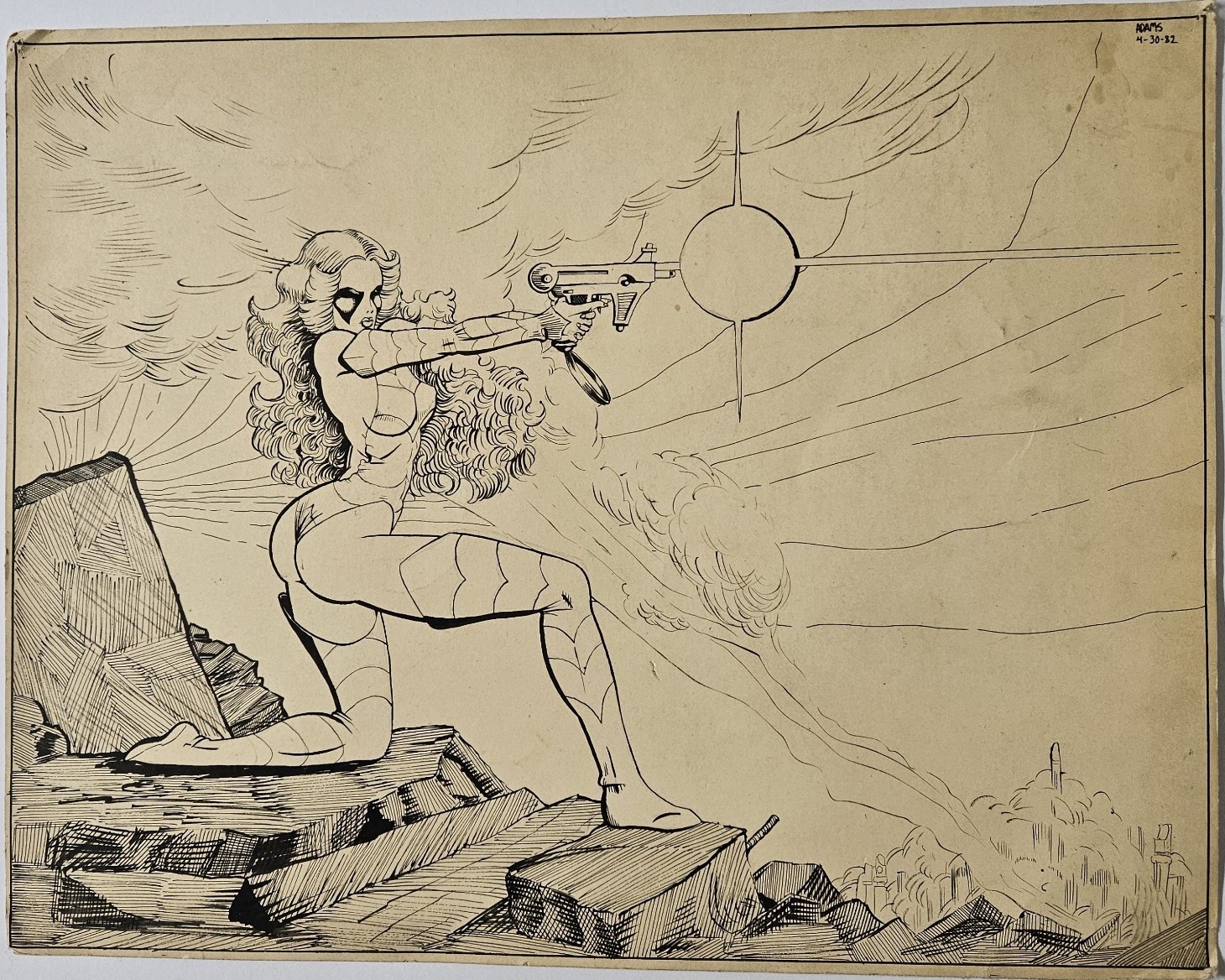
1982 The Dream Takes Shape / Marionette - Micronauts (April 30th, 1982)
'The Dream Takes Shape' is one of the most historically significant surviving artworks from the months immediately preceding his professional career. Drawn just weeks after his 19th birthday, it captures the exact period when Adams was transforming from an aspiring fan artist into a young professional actively pursuing work in the comic book industry. At the same time, he was working a regular job at the Round Table Pizza in Vacaville, California. He had chosen to work a few miles from his home instead of making the much longer drive to attend college. Aside from art classes he took in high school, he was a completely self-taught artist. Around this time, Adams was making another major decision about his future. He had spent approximately two years involved in acting and community theater, but quit acting around the time he turned 19, choosing to concentrate on becoming a professional artist.
Spring 1982 was a pivotal moment in Adams' life. His first published comic story had just appeared in High Energy, he was producing artwork to sell at comic conventions, and he was building the portfolio that would eventually earn him professional assignments. In his artist profile published in High Energy, Adams openly stated that his dream was to draw Micronauts—the comic book that had inspired him to become a comic book artist in the first place. That statement and this drawing were created during virtually the same period, making the Marionette artwork far more than a sketch or portfolio piece. It is a visual expression of the career goal he was publicly declaring at the time.
The choice of subject could hardly have been more meaningful. Marionette was the heart of Micronauts—one of the series' central characters and a symbol of the imaginative world that had inspired Arthur Adams to pursue comic books in the first place. Arthur was 15 years old when Micronauts debuted in 1978, and he was deeply inspired by Michael Golden's artwork on the series. Rather than drawing whatever might have been commercially popular, he chose to devote his time to illustrating the character from the comic that had changed the course of his life. In many ways, this artwork represents a young artist bringing his ambitions to life on paper, focusing not simply on a Marvel character, but on the world he hoped one day to help create.
The artwork also documents the humble beginnings of his career. Adams personally sold drawings like this from his own convention table while trying to establish himself within the comics community. The original $15 price, still written on the back of the artwork, serves as a remarkable reminder that one of the industry's future superstars was, at the time, simply a talented young artist hoping someone would believe in his work enough to buy it.
Even at this early stage, many of the qualities that would later define Arthur Adams' art are already unmistakable. The confident line work, expressive face, careful anatomy, flowing hair, dynamic pose, and attention to costume detail all foreshadow the style that would soon make him one of comics' most celebrated artists. Although still refining his craft, the foundation of the "Arthur Adams look" is already clearly visible.
'The Dream Takes Shape' also occupies a unique place in Adams' artistic chronology. It is currently the earliest known surviving artwork by Arthur Adams depicting a character owned by Marvel Comics, predating his professional Marvel career by nearly a year. It stands at the beginning of a remarkable journey that would culminate in his hiring by Marvel in 1983, where, fittingly, one of his earliest published assignments included inking the cover of Micronauts: The New Voyages #2.
Taken as a whole, the Marionette artwork is far more than an attractive early drawing. It is a rare historical document from the moment Arthur Adams' dreams were beginning to become reality—a piece created while he was openly declaring his ambition to draw Micronauts, selling artwork directly to fans at conventions, and steadily working toward a professional career. Few surviving artworks capture so clearly the point where an aspiring young artist stood on the threshold of becoming one of the most influential comic book illustrators of his generation.
-

-

1982 Creature From the Black Lagoon (May 9th, 1982)
Arthur Adams' lifelong love of classic movie monsters makes it no surprise that he chose to illustrate the Creature from the Black Lagoon, one of Universal's most celebrated horror icons. The drawing reflects his appreciation for the timeless monster films that helped shape his imagination long before he became a professional comic book artist.
-

1982 Red Sonja (June 15th, 1982)
Fantasy heroines continued to inspire Arthur Adams throughout 1982, making Red Sonja a fitting addition to his growing body of work. Her combination of strength, beauty, and adventure perfectly matched the kinds of characters he most enjoyed bringing to life.
-

Mid 1982 Fara Foxette
Created as a playful tribute to the famous Farrah Fawcett poster, Fara Foxette gave Arthur Adams the opportunity to blend contemporary pop culture with the humorous world of the Zoo Crew. The illustration soon became his first paid published artwork, marking an important milestone on the path to his professional comic book career.
-

Mid 1982 Micronauts
Created with fellow aspiring artist Art Nichols, this 'Micronauts' collaboration reflects the enthusiasm of two young creators inspired by the comic that had such a profound impact on Arthur Adams' career ambitions. Looking back, the drawing captures a moment when Arthur was still chasing the dream of one day contributing to the very series that had first convinced him to become a comic book artist.
-

1982 Eclipso (August 15th, 1982)
Created as a convention sketch, Eclipso gave Arthur Adams another chance to showcase his growing versatility to fans and potential buyers. The character's striking costume and supernatural themes made for an eye-catching commission that demonstrated his ability to bring even lesser-known heroes and villains to life.
-

1982 Darth Vader (August 22nd, 1982)
Science fiction remained a major source of inspiration for Arthur Adams, and Darth Vader offered the opportunity to tackle one of the most visually powerful characters of the era. The sketch shows his growing confidence in bringing legendary pop culture icons to life.
-

Fall 1982 Sticker Designs Page 1
-

Fall 1982 Sticker Designs Page 2
-

Fall 1982 Sticker Designs Page 3
Created as a series of 90 sticker designs for a local comic book store (Berkeley - Comics & Comix?), these illustrations reveal the incredible range of characters that captured Adams' imagination before his professional career began. Spanning superheroes, villains, science fiction, and fantasy, the collection serves as a fascinating snapshot of the pop culture influences that helped shape one of comics' future superstars. Perhaps Arthur had more free time to create these dozens of tiny sketches, as it was around this period that he left the pizza job he had worked at for about a year.
-
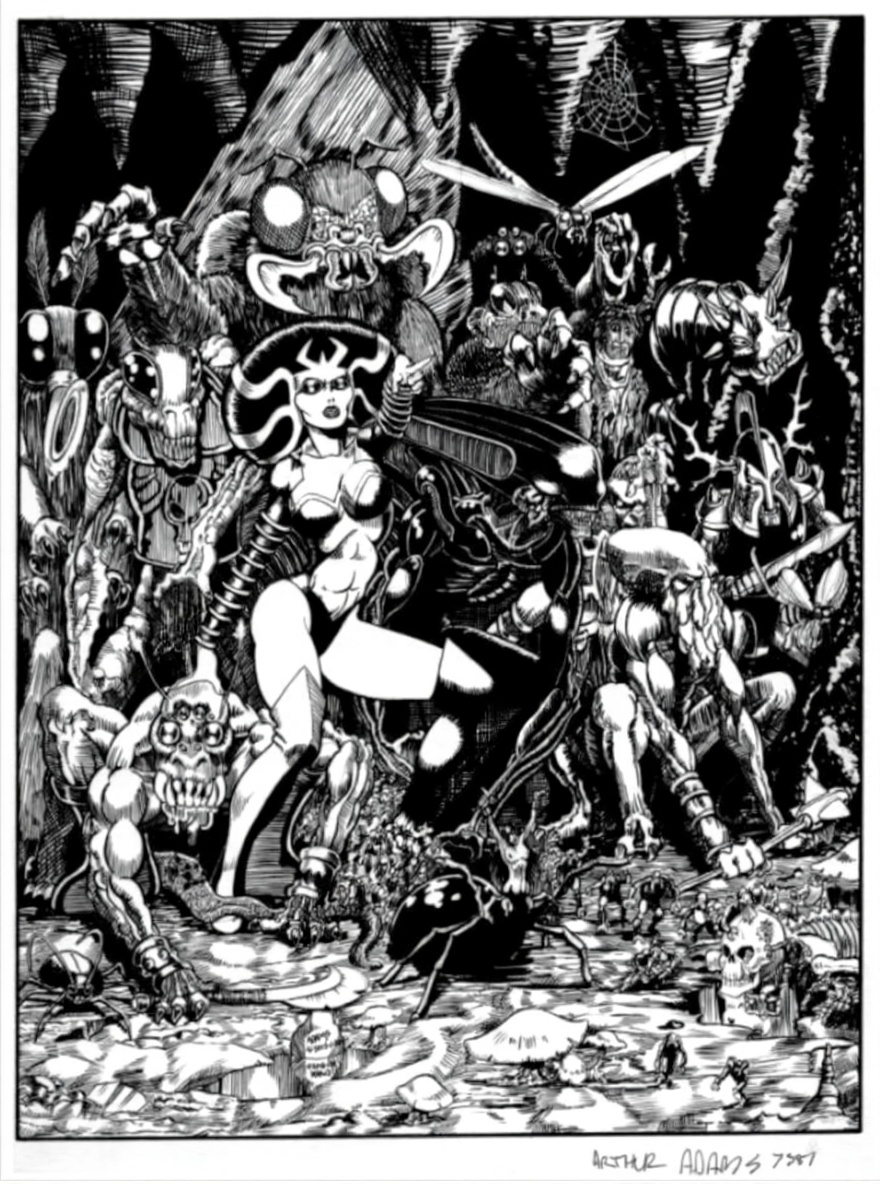
1982 Lightning Lady and Insectons (September, 1982)
With Jack Kirby's Captain Victory introducing readers to Lightning Lady and the Insectons in 1982, Arthur Adams turned his attention to one of the King's newest creations rather than one of his classic Marvel characters. The illustration reflects a young artist keeping pace with the latest work of one of comics' greatest visionaries while continuing to broaden his artistic range.
-

1982 Clea (September, 1982)
Arthur Adams wasn't above poking a little fun while drawing fantasy characters. The playful humor gives the illustration a charm that sets it apart from many of his more straightforward early works. This also marks the second known collaboration between Arthur Adams and inker Art Nichols.
-

1982 Taarna (October, 1982)
This illustration depicts Taarna, the iconic warrior heroine from the 1981 animated film 'Heavy Metal'. As one of Arthur's earliest known fantasy character illustrations, it highlights the wide range of influences that inspired the nineteen-year-old artist while foreshadowing the powerful female characters that would become a hallmark of his later work.
-

1982 Elektra in CBG #473 (October 14th, 1982)
With Elektra rapidly becoming one of Marvel's most popular new characters, Arthur Adams' illustration for Comics Buyer's Guide #473 gave him an opportunity to showcase his talent before a national audience. Published just months before his professional career began, the piece hints that the wider comic book community was already beginning to notice his remarkable potential.
-

1982 Elektra (October 18th, 1982)
Elektra's explosive popularity in 1982 made her a compelling subject for Arthur Adams, whose growing appreciation for Marvel's dynamic characters was becoming increasingly evident in his artwork. Revisiting the character only days after the other Elektra illustration suggests he recognized her as an ideal showcase for the graceful action and dramatic compositions he enjoyed drawing.
-

Late 1982 Red Sonja
Created alongside fellow aspiring artist Mike Mignola, this Red Sonja illustration captures a remarkable moment when two future comic book legends were still refining their craft. Looking back, the drawing stands as a fascinating snapshot of two young creators whose careers would soon take very different, yet equally influential, paths.
-

Late 1982 Demon Sample Page
Created as a sample page for DC Comics, this Demon sequence gave Arthur Adams the opportunity to prove he could handle the storytelling, pacing, and dramatic action required of a professional comic book artist. Looking back, it stands as an important stepping stone, revealing a young artist actively turning his ambition into a career.
-

1982 Wolverine (November 17th, 1982)
Wolverine's rapidly rising popularity made him an exciting subject for Arthur Adams, whose admiration for Marvel's characters continued to grow as he pursued a career in comics. Drawn just months before Marvel would hire him, the illustration now stands as a remarkable glimpse of a young artist depicting one of the very heroes he would one day officially bring to life.
-

1982 Storm (November 20th, 1982)
Storm's striking visual design and commanding presence made her a natural subject for Arthur Adams as he continued refining his portfolio in late 1982. The illustration reflects his growing attraction to Marvel's most dynamic characters just months before he would begin drawing them professionally.
-

1982 Star Wars - Han Solo & Chewbacca (November 25th, 1982)
The enormous success of 'Star Wars' continued to inspire Arthur Adams in 1982, making Han Solo and Chewbacca an ideal subject for exploring two of popular culture's most beloved heroes. The illustration reflects his enthusiasm for science fiction adventure and demonstrates that his artistic interests extended well beyond the world of comic books.
-

1982 Best Fishes - Penguin Wearing a Santa Hat (December 2nd, 1982)
Created during the 1982 holiday season, this whimsical Christmas illustration shows that Arthur Adams enjoyed drawing lighthearted subjects just as much as action heroes and fantasy characters. Its playful humor and cheerful spirit offer a glimpse of the warmth and personality that would later become a beloved part of his artwork.
-
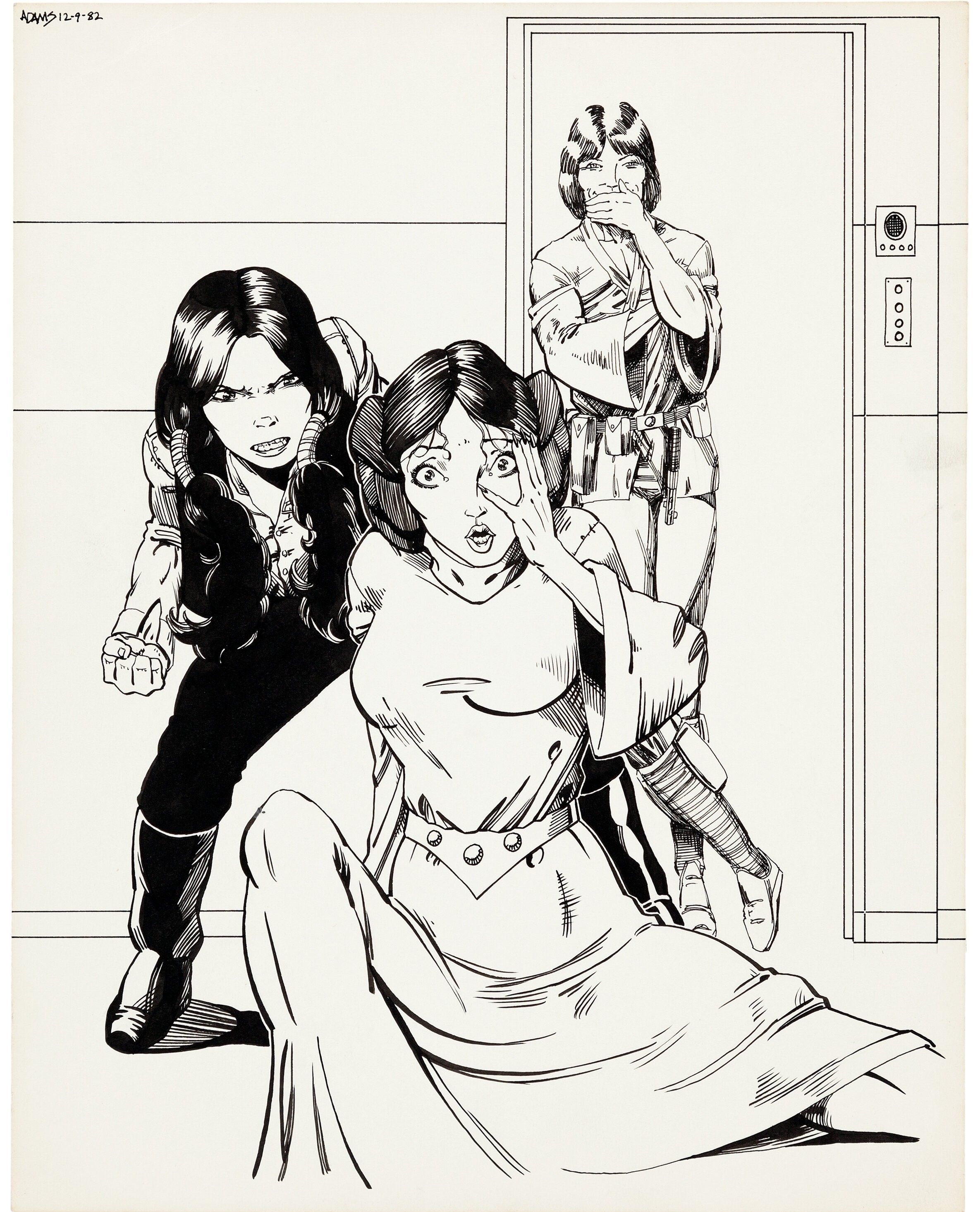
1982 Star Wars - Shira Brie, Leia & Luke (December 9th, 1982)
Rather than relying on action alone, Arthur Adams uses the expressions of Shira Brie, Leia, and Luke to tell a complete story without a single word of dialogue. The contrasting emotions on each character's face demonstrate an early mastery of visual storytelling, revealing how much could be communicated through expression and body language alone.
-

1982 Dawnstar (December 12th, 1982)
Dawnstar's elegant costume, graceful movement, and distinctive visual design made her an appealing subject for him as he continued expanding the range of characters in his portfolio. Drawn only months before his professional breakthrough, the illustration reflects his growing confidence in bringing dynamic female superheroes to life. This marks the third known collaboration between Arthur Adams and inker Art Nichols in 1982, and the colors also appear to have been applied by Arthur himself.
-

1982 Dawnstar (December 27th, 1982)
Returning to Dawnstar only weeks later, Arthur Adams appears to have revisited the character with a renewed determination to refine and improve his earlier effort. The result is a stronger, more confident illustration that reveals how rapidly his skills were evolving during the closing weeks of 1982.
-

1982 Werewolf (December 29th, 1982)
Arthur Adams' fascination with classic horror made a werewolf a natural subject as 1982 drew to a close, allowing him to revisit the monster themes he had enjoyed throughout the year. The illustration demonstrates that even while his professional opportunities were beginning to emerge, he continued to draw the creatures and genres that had inspired him from the beginning.
-

1982 Wolverine (December 30th, 1982)
More than just a Wolverine pinup, this artwork serves as the culmination of a year defined by relentless determination. Over the course of 1982, Arthur Adams devoted nearly every spare moment to improving his craft, creating independent comics, convention sketches, sample pages, self-published prints, and portfolio pieces while chasing a dream that still offered no guarantees. Month by month, his confidence, anatomy, storytelling, and draftsmanship grew stronger. By the time this drawing was completed, the uncertain young artist seen at the beginning of the year had evolved into someone unmistakably ready for the opportunities that lay ahead.
There is a fitting symbolism in his choice of subject. Like Wolverine himself, Arthur Adams met every obstacle with quiet resolve, pressing forward through persistence rather than certainty. He wasn't driven by fame or instant success, but by an unwavering belief that his work could become something greater if he simply refused to stop. As the final known artwork of 1982, this image stands as both the closing chapter of an extraordinary year and a portrait of the determination that would soon carry him into a professional career.
Its journey did not end in 1982. Nearly four decades later, Marvel revisited this early illustration, publishing it as the cover for 'X Lives of Wolverine' #1 Hidden Gem Variant (March 2022). Originally created by an aspiring young artist with nothing more than determination and a dream, the drawing ultimately returned to the very publisher he had worked so tirelessly to join—a fitting tribute to both the artwork and the remarkable journey that began with it.
With the completion of this Wolverine illustration, the story told throughout these images reaches its conclusion. Over the course of roughly two and a half years, readers have witnessed Arthur Adams evolve from a seventeen-year-old high school student experimenting with watercolor and fantasy illustration into a confident young artist ready to enter the professional comic book industry. Every surviving painting, sketch, convention drawing, published page, and portfolio sample represents another step along that remarkable path. Within only a few months, Marvel Comics would hire him to work on Longshot, forever changing the course of his life. The unknown teenager whose earliest fantasies filled this page would soon become one of the most influential comic book artists of all time. The dream had become reality.
-